Venue background
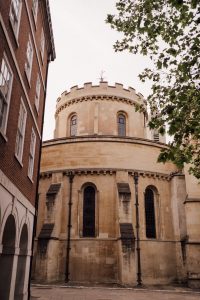
The Honourable Society of the Inner Temple dates back many hundreds of years, during which time its buildings have been periodically rebuilt due to fire, decay, damage, or wartime destruction. The majority of the buildings you see today, with the exception of the Temple Church and those constructed post-war, were built during the period spanning the late-seventeenth and mid-nineteenth centuries. An excellent history of the each of the buildings and their predecessors can be found on the Inner Temple Library website.
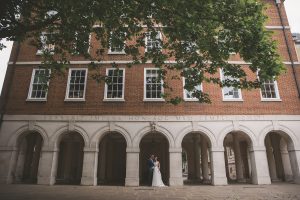
The Inner Temple estate, together with the Middle Temple estate, comprises the Temples Conservation Area, and contains one of the largest concentrations of Grade I listed buildings in London, with many of the others being listed Grade II* or II.
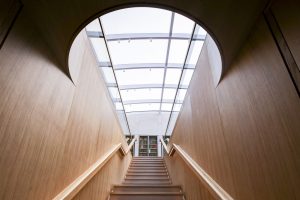
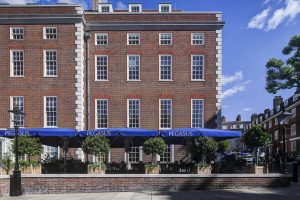
Only the parliament chamber (1680) and clocktower (1686) had survived the fire of 1737. The Georgian facade (in Portland stone) was added in 1740 when Thomas Blencowe was Treasurer. At the left is the Crown Office Row building of 1737 (destroyed 1941).
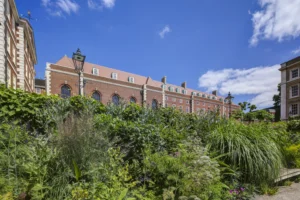
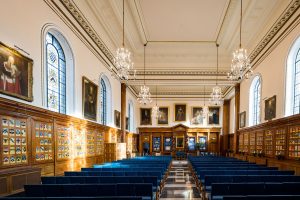
The Old Hall
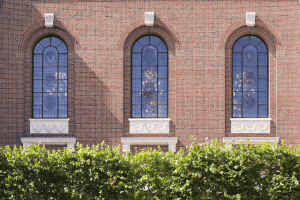
The old hall underwent many changes before its demolition in 1868. The new hall of 1870 reflected the same architectural taste, but was 92 feet long, and with much ornamental detail. The windows included scenes from English history, such as the battle of Hastings and the Assize of Clarendon, pictures of Bracton (writing his book) and various other legal figures, together with historical personages from Alcuin to the Duke of Wellington; the great west window depicted Queen Victoria with four virtues representing Law and Government. At the east end was a marble bust of Queen Victoria, and (in the gable) Thornhill’s painting of Pegasus from the old hall.
The Middle Temple
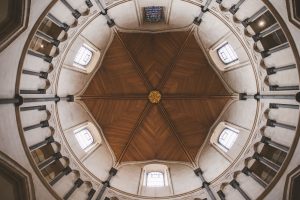
No attempt was made in the 1950s to reproduce the medieval appearance of the older halls, but a neo-Georgian style was preferred, with light coloured oak. The tradition was nevertheless continued of placing the readers’ coats of arms around the walls; the present shields were painted by Frank Newsome Berry. The armorial windows (mostly by Hugh Easton) commemorate members of the Inn who have held the great seal, two Royal Benchers who acceded unexpectedly to the throne (James II and George VI), and (in the west window) Robert Dudley, earl of Leicester. Dudley’s arms were ordered in 1561 to be displayed in Hall ‘as a continual monument of his lordship’s goodness and great goodwill towards this House’ in saving Lyons Inn from the claims of the Middle Temple.
The Parliament Chamber
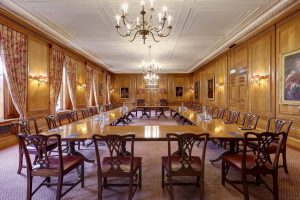
In the Parliament Chamber is a piece of elaborate wood carving, inscribed ‘T Thoma Walker Ar 1705′ and formerly attributed to Grinling Gibbons, which was removed for safety during the bombing. A carving of pegasus in marble by J. M. Rysbrack, made in 1737 for the Hall entrance, was also saved from the ravages of war and is now set above the benchers’ doorway opposite the Parliament Chamber. Most of the paintings belonging to the Inn were removed during the Blitz and still adorn the walls of these central buildings; they include the full-lengths of Coke and Littleton (given in 1662) which used to dominate the old Hall, and those of King William III, Queen Mary II and Queen Anne, commissioned by the Inn from Sir Godfrey Kneller (1694, 1702).
Contact
If you are interested in planning an event or would like further information about The Inner Temple then please get in touch and we will reply as soon as possible.